What enterprise n8n teams do that small teams skip
Notes from n8n In The Loop 2026 in Berlin on how Mercedes-Benz, Microsoft and SAP run n8n in production, and which of their operating practices are worth copying at a smaller scale.
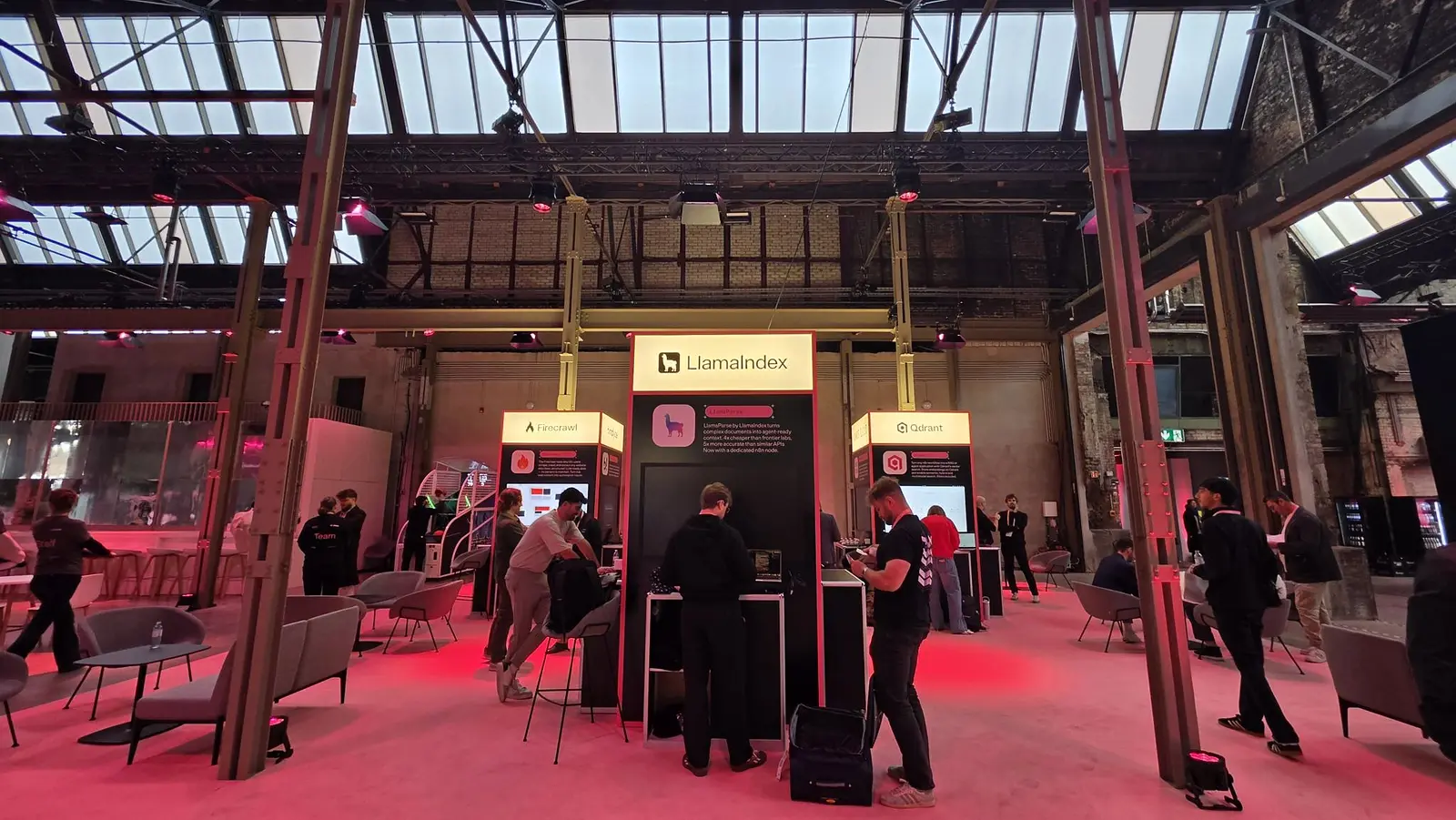
On 14 October, n8n held its first conference in Berlin, at Wilhelm Studios, an industrial building in the north of the city. In The Loop 2026 put the people who build workflows for a living in the same rooms as the platform teams running n8n inside Mercedes-Benz, Microsoft, SAP, Bayer, Nvidia, Bosch, Telus and Albertsons.
The product announcements from the day are documented elsewhere. The part that is harder to get from the outside is how a large organisation operates n8n after it stops being a side project: who is allowed to change a workflow, how it reaches production, how it is watched, and where its data is allowed to go.
Most of it is not exotic. It is the ordinary discipline a small team skips until something breaks.
Building the workflow is the easy part
Every enterprise session landed on the same point. Creating a workflow is a few hours of work. Keeping it correct for two years, across staff changes and platform upgrades, is the actual project.
Michael Deptuch from Mercedes-Benz framed this as a platform problem rather than an automation problem. His session covered custom nodes, role based access and data governance on one side, then templates, automated deployments, and observability and KPIs on the other.[1]
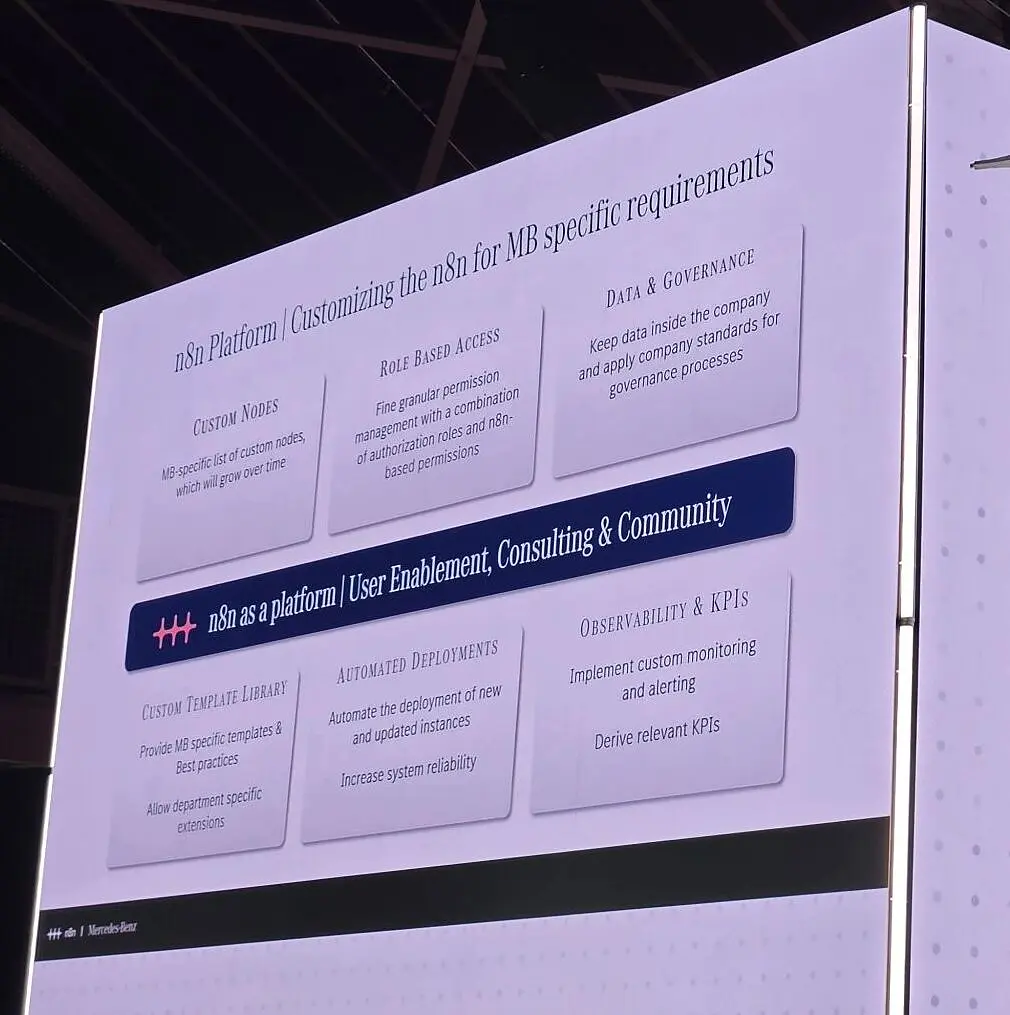
The Mercedes-Benz platform slide. The left column sets what is allowed. The right column makes the allowed thing repeatable. Photographed during the session.
That split is the useful part. A team can adopt the first half without the second and end up with rules nobody can follow. It can adopt the second half without the first and end up with fast deployments of workflows nobody approved.
Who is allowed to build and deploy
At enterprise scale, n8n stops being one person’s tool and becomes shared infrastructure. That raises a question most small teams have never had to answer: if anyone can edit a workflow that touches invoices, who is accountable when it fails?
Mercedes-Benz answered it with role based access and fine grained permissions assembled from roles and rights, so access follows a function rather than a favour. Bitovi ran a session on the centre of excellence model for governing n8n in an enterprise, which is the organisational version of the same idea.[1]
A small team does not need a centre of excellence to apply the principle. It needs a named owner for each workflow that matters, and edit rights limited to people who understand what the workflow does.
Templates and deployments as a product
The second half of the Mercedes-Benz platform work treats templates and deployments as deliverables to maintain, not chores to repeat.
Their slide listed a custom template library with company specific templates and best practices, department specific extensions, automated deployment of new and updated instances, and increased system reliability as platform scope. A department that wants a new automation starts from an approved pattern instead of inventing its own from scratch.
The cheap version of this for a small team is one worked example per recurring task, kept somewhere shared, plus a written rule for how a change reaches production. That is a folder and an afternoon, and it removes the same class of mistake that enterprise template libraries exist to remove.
Observability and KPIs
One phrase repeated across sessions: unexpected behaviour. How do you explain it, and how do you keep it from coming back?
Mercedes-Benz listed custom monitoring and alerting, and deriving relevant KPIs, as part of their platform work. n8n’s own team ran a session on bringing their internal workflow sprawl under control. Execution data is the raw material for both, and it is where a lot of teams stop. An execution log tells you what ran. It does not tell you whether the workflow still does what the business thinks it does.
The minimum viable version for a small team is an alert on the workflows that touch money, customers, or compliance, plus a weekly look at failure counts. A workflow with no alert and no owner is invisible until a client notices.
Data and governance
Governance sounds like a legal topic until you read the slides. Mercedes-Benz described it as keeping data inside the company and applying company standards to governance processes. Microsoft’s session placed n8n in the execution layer of an enterprise AI architecture, with identity, data and governance as the layers that make everything above them safe to operate. A separate talk argued for sovereign AI as a team sport.[1]
The question for any team is smaller than it sounds: which systems may this workflow read from, and where is the data allowed to be processed. A workflow that sends customer records to a third party model is a business decision, not a configuration detail.
The agent question
Agents were the centre of the agenda, and the enterprise sessions were the most sober about them.
Microsoft presented n8n as a control plane to build, deploy and govern AI workflows and agents alongside Copilot Studio, Azure AI Foundry and Microsoft Agent 365. SAP showed the path from individual agents to end to end agentic processes with n8n inside Joule Studio. Bayer’s session covered sharing memory, governance and logic across agents.[1]
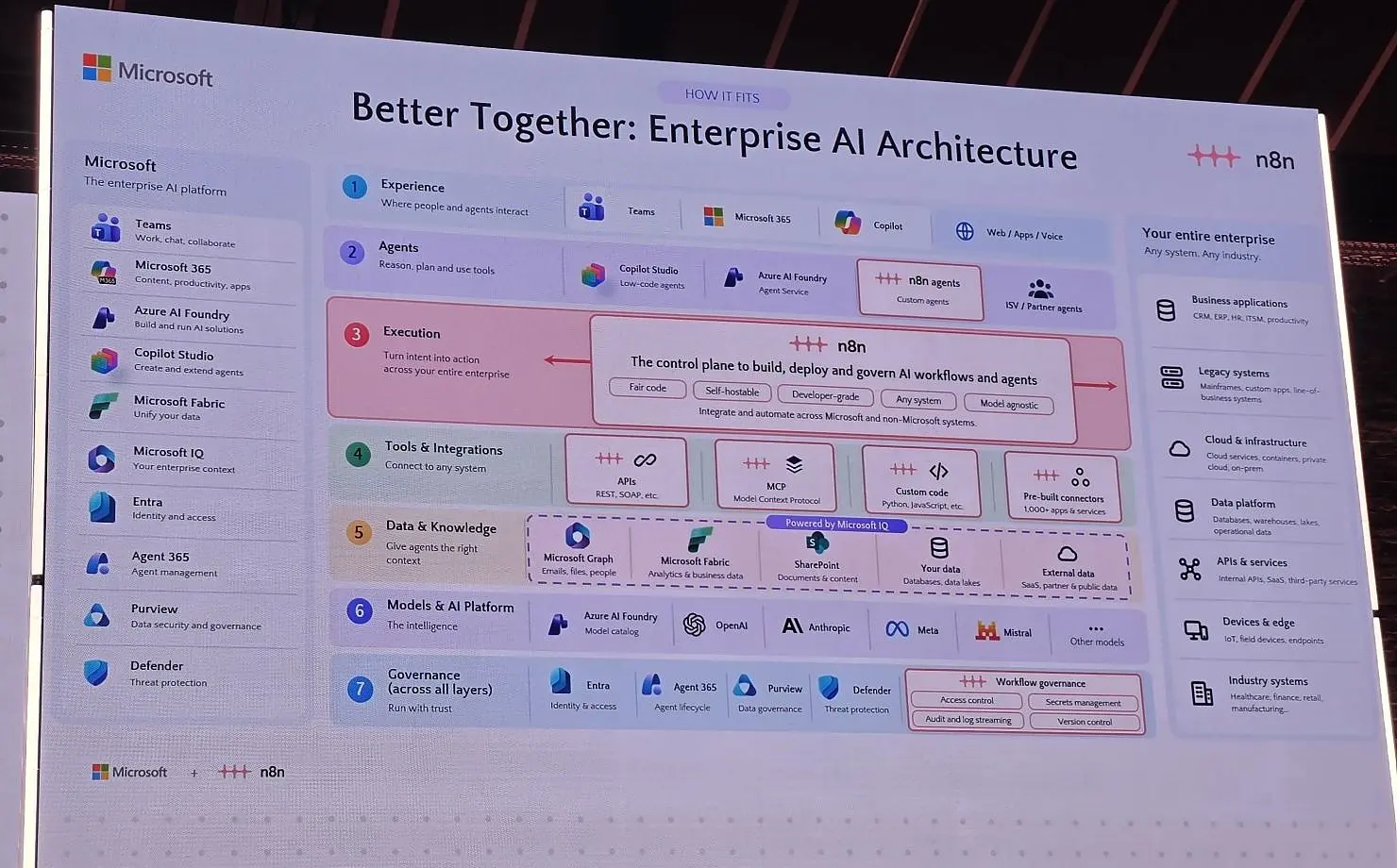
The Microsoft session put n8n in the execution layer and framed the layers around it as the reason enterprise deployments hold together. Photographed during the session.
The consistent message was that an agent is only as useful as the permissions, data and review process around it. Model capability is the easy variable to compare. Those three are the ones that decide whether an agent is allowed near a real process.
Platform signals worth knowing
If you are choosing where to place long lived automation, the supplier matters as much as the feature list.
In May 2026 SAP made a strategic investment in n8n and signed a multi-year partnership to embed n8n inside Joule Studio, at a reported valuation of $5.2bn.[2] n8n reports more than 1,400 enterprise customers and 1.7 million monthly active builders.[2] The event also included a session on the Campus Ambassador Program, which is n8n investing in the next generation of builders.[1]
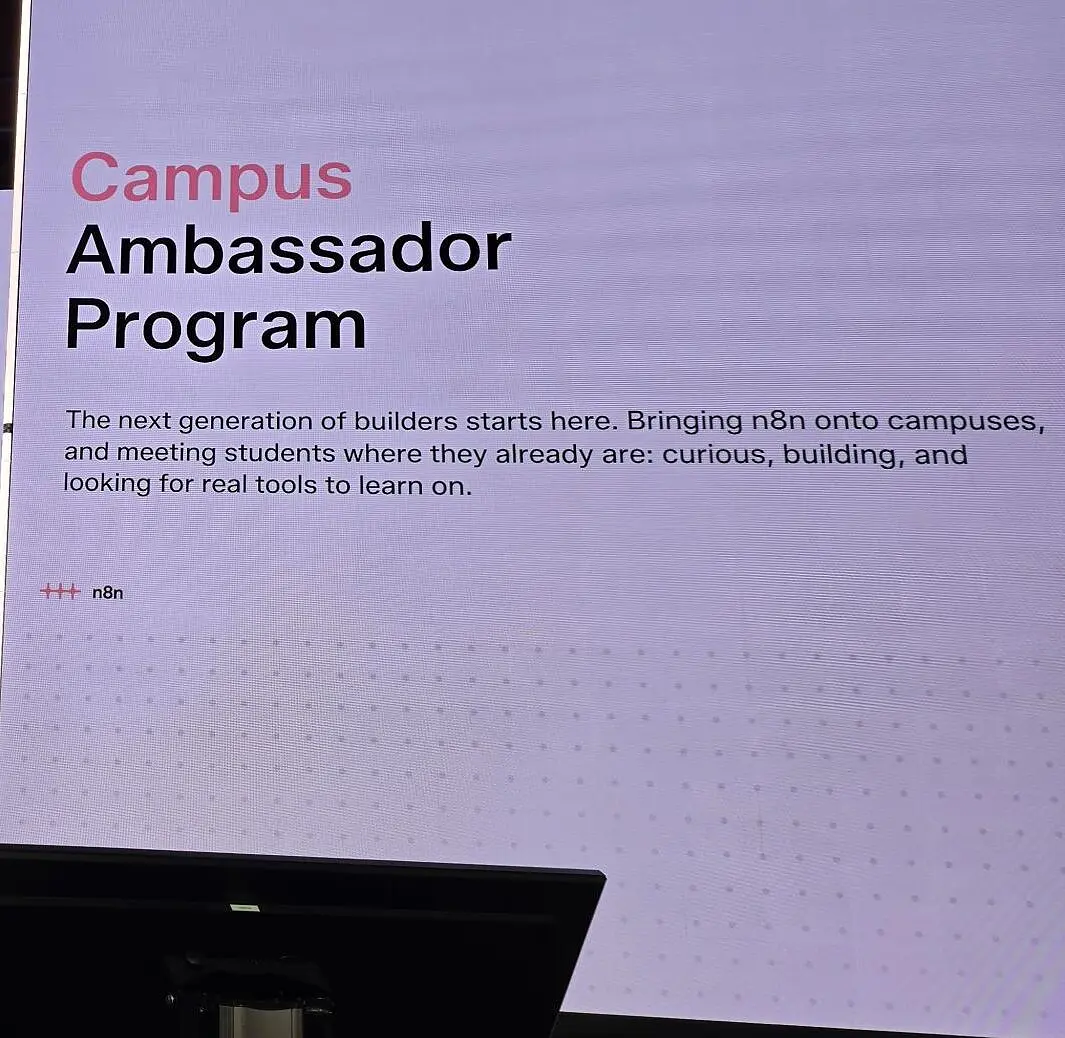
The Campus Ambassador session, part of a wider push into universities and student communities. Photographed during the session.
None of this makes a platform decision for you. It does change the hiring pool, the direction of integrations, and the odds that the tool is still maintained when your oldest workflow is five years old.
What a small team should copy now
- Name an owner for every workflow that matters. One person, by name.
- Keep test and production apart, even if production is a single carefully run instance.
- Start recurring tasks from an approved template instead of rebuilding the same thing per client.
- Alert on the workflows that touch money, customers, or compliance.
- Write the failure path down: what happens when the API is down, the credential expires, or the model returns something unusable.
- Decide what data may leave your systems before the workflow ships, not after.
- Keep a change history that answers “what changed” in one place.
What you can ignore at this size
The enterprise sessions were honest that their structures exist because of their scale.
A centre of excellence, a seven layer architecture, a dedicated platform team and a formal release pipeline are answers to coordination problems a team of three does not have. Adopting them early adds process without adding reliability.
The filter that matters is failure cost. Add control where a failure reaches a customer, a payment, or a regulator. Leave the rest light until it earns the weight.
Where this leaves us
The gap between a working workflow and a dependable system is operational, not technical. Enterprises have to close it because they cannot afford not to. Smaller teams get to choose when.
Choosing early is cheaper than choosing after an incident.
If your team runs automation that has outgrown one person’s memory, book a fit check. We will map the current system, name the failure modes, and decide what is worth tightening first.
Sources
[1] Agenda, n8n In The Loop 2026
[2] n8n valuation doubles to $5.2bn as SAP makes strategic investment, n8n